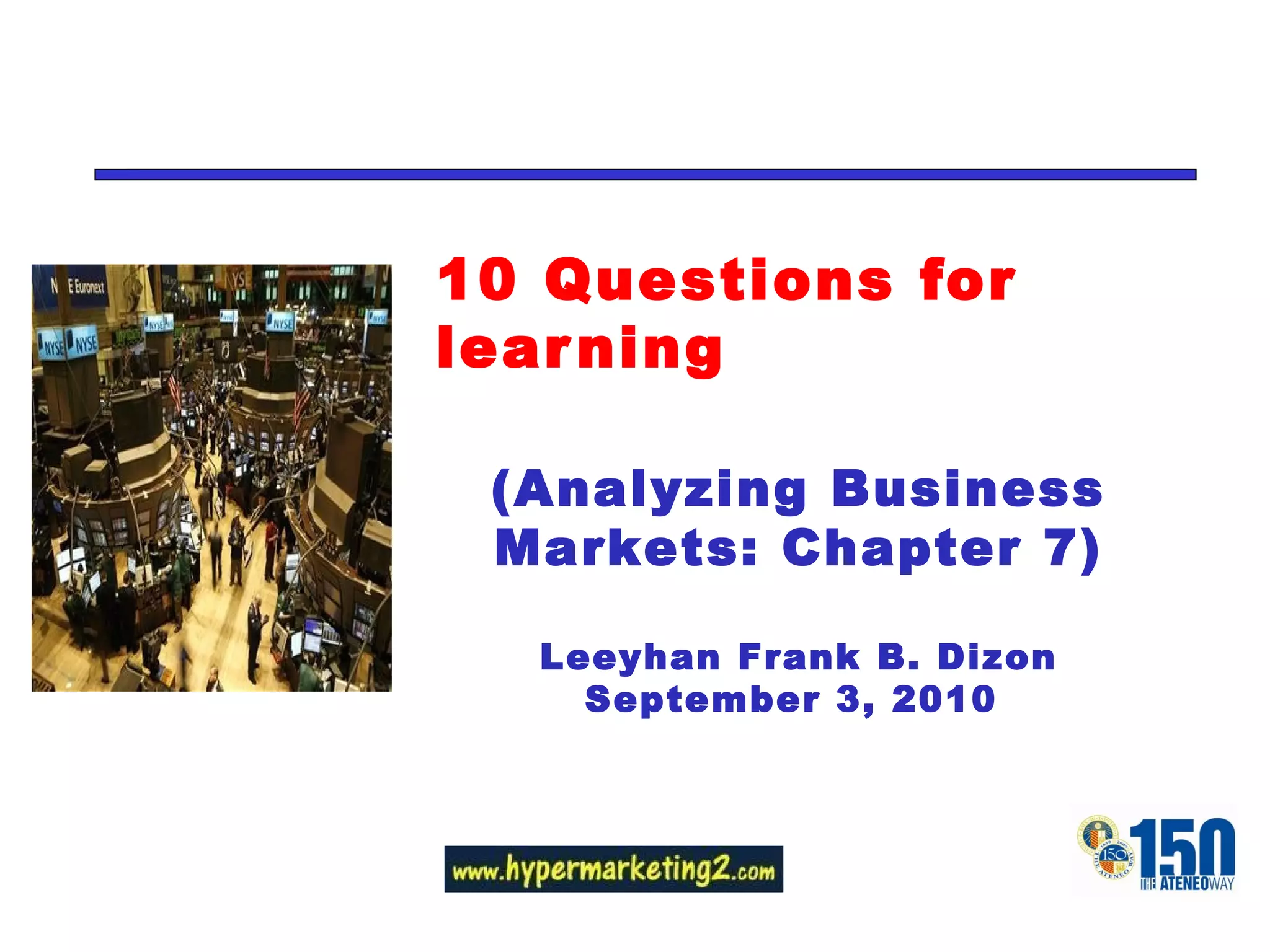
10 Questions for learning (Analyzing Business Markets: Chapter 7) Leeyhan Frank B. Dizon September 3, 2010
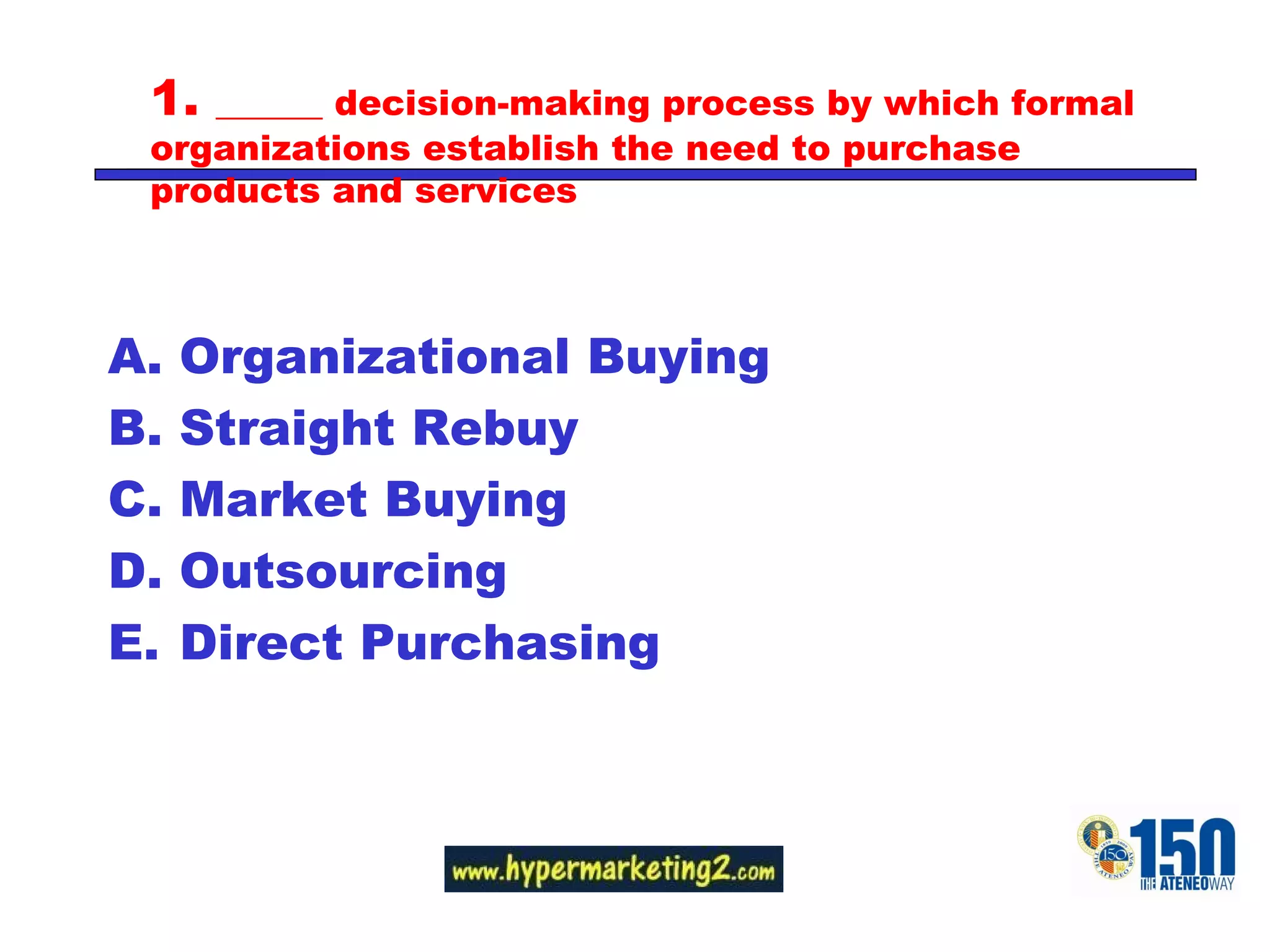
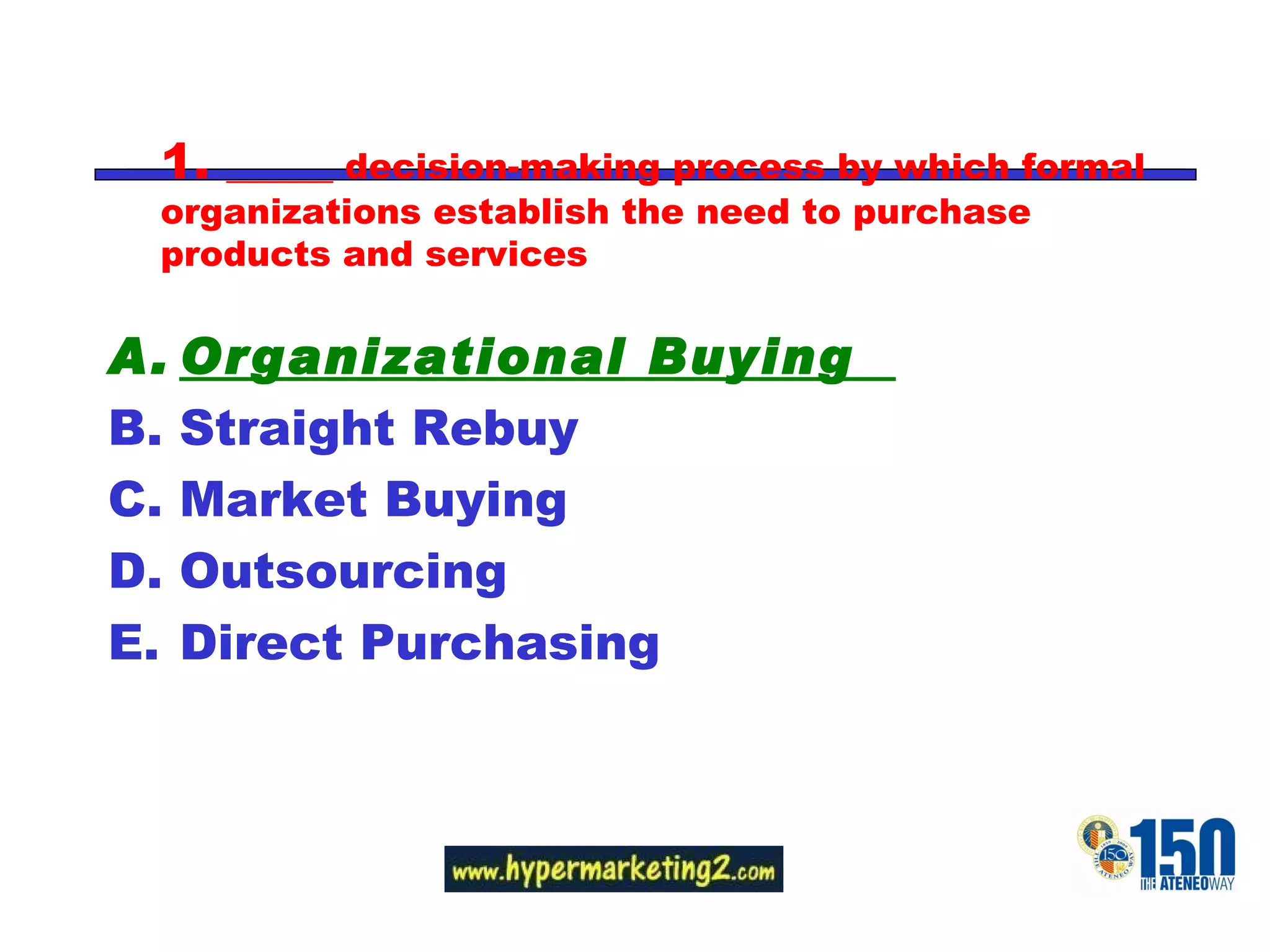
1.  ______ decision-making process by which formal organizations establish the need to purchase products and services Organizational Buying  Straight Rebuy Market Buying Outsourcing Direct Purchasing
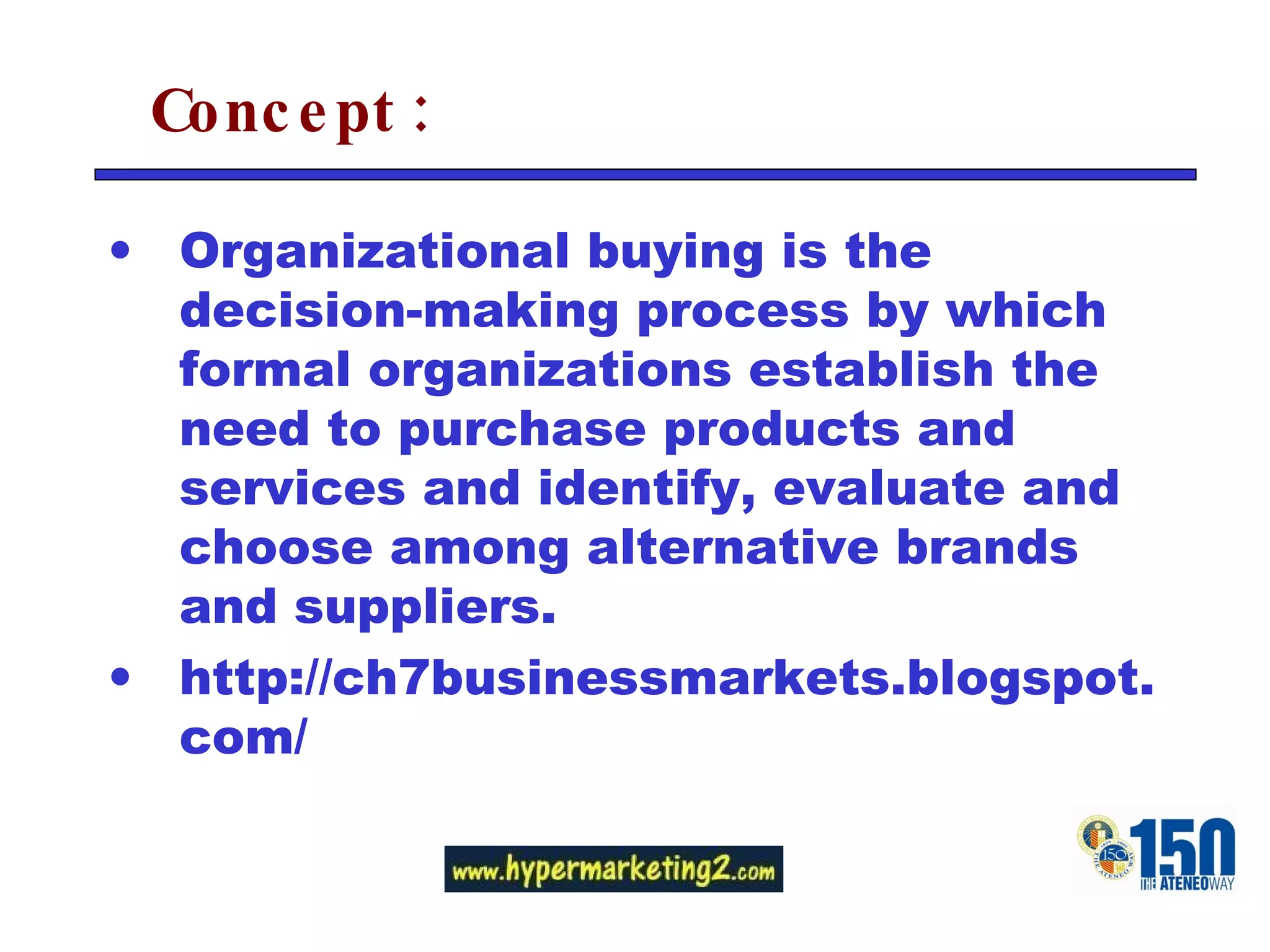
Concept: Organizational buying is the decision-making process by which formal organizations establish the need to purchase products and services and identify, evaluate and choose among alternative brands and suppliers. http://ch7businessmarkets.blogspot.com/
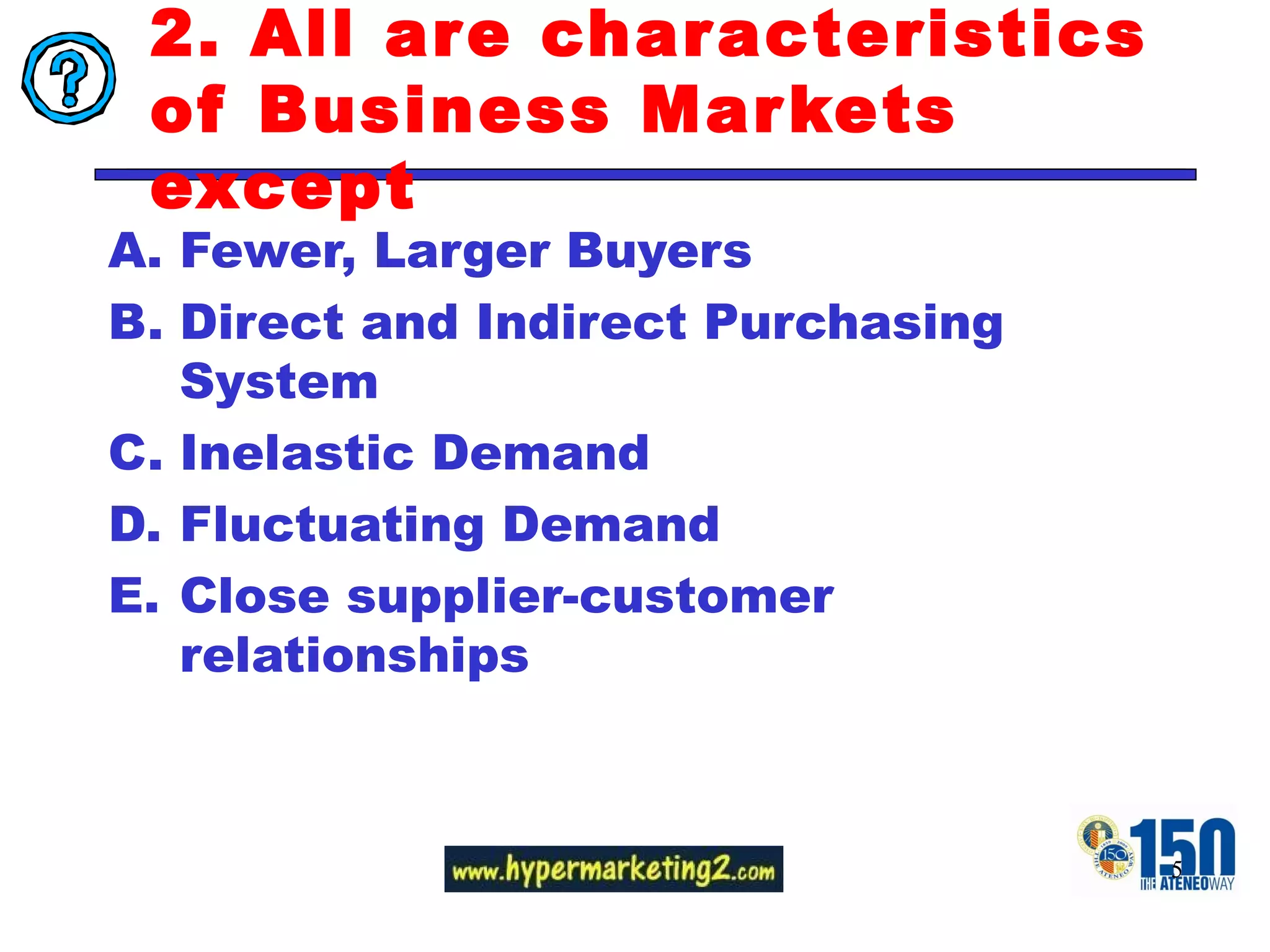
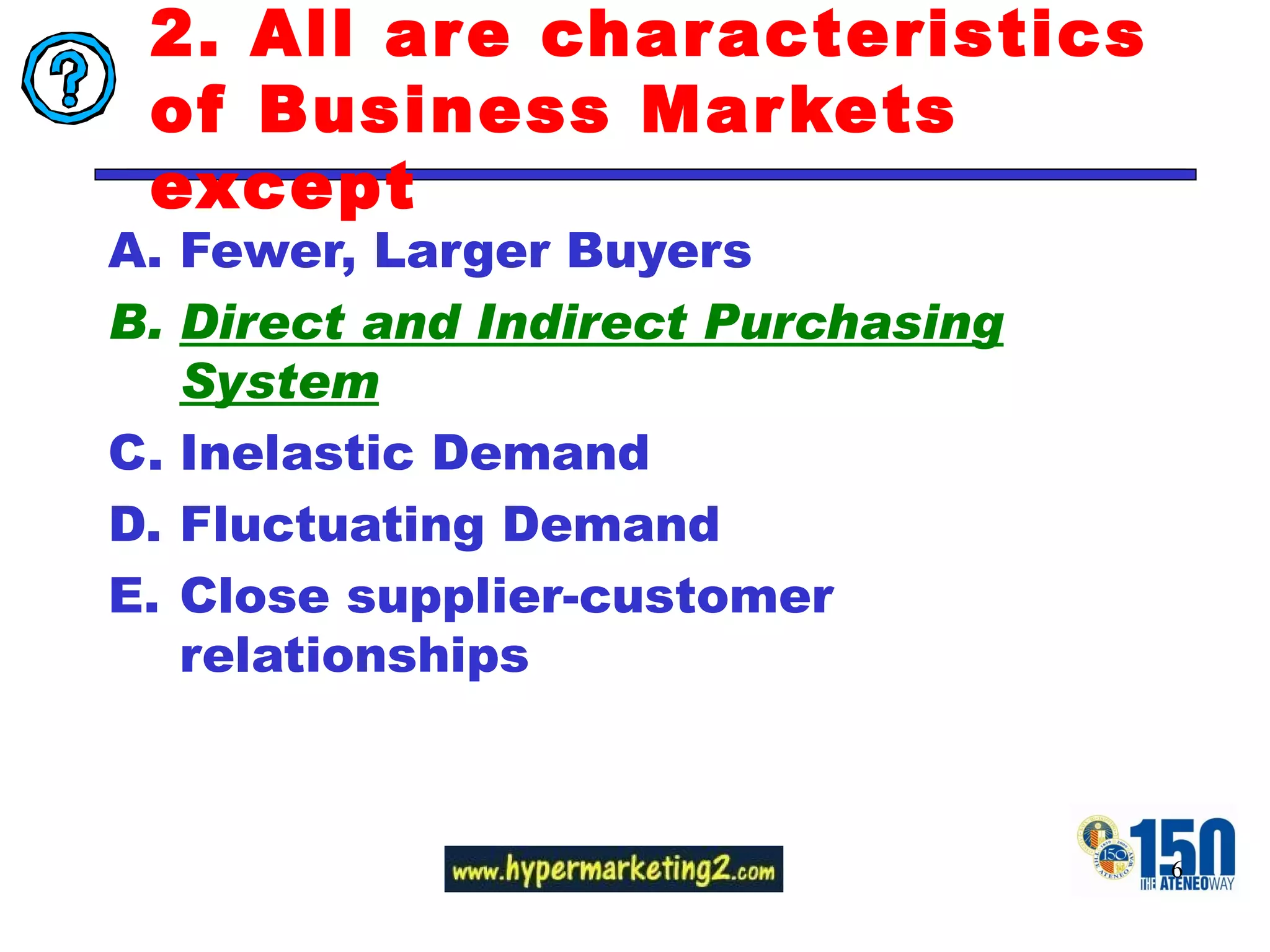
2. All are characteristics of Business Markets except  Fewer, Larger Buyers Direct and Indirect Purchasing System Inelastic Demand Fluctuating Demand Close supplier-customer relationships
Concept: Slide number 3 from the reading materials  “ Characteristics of Business Markets”
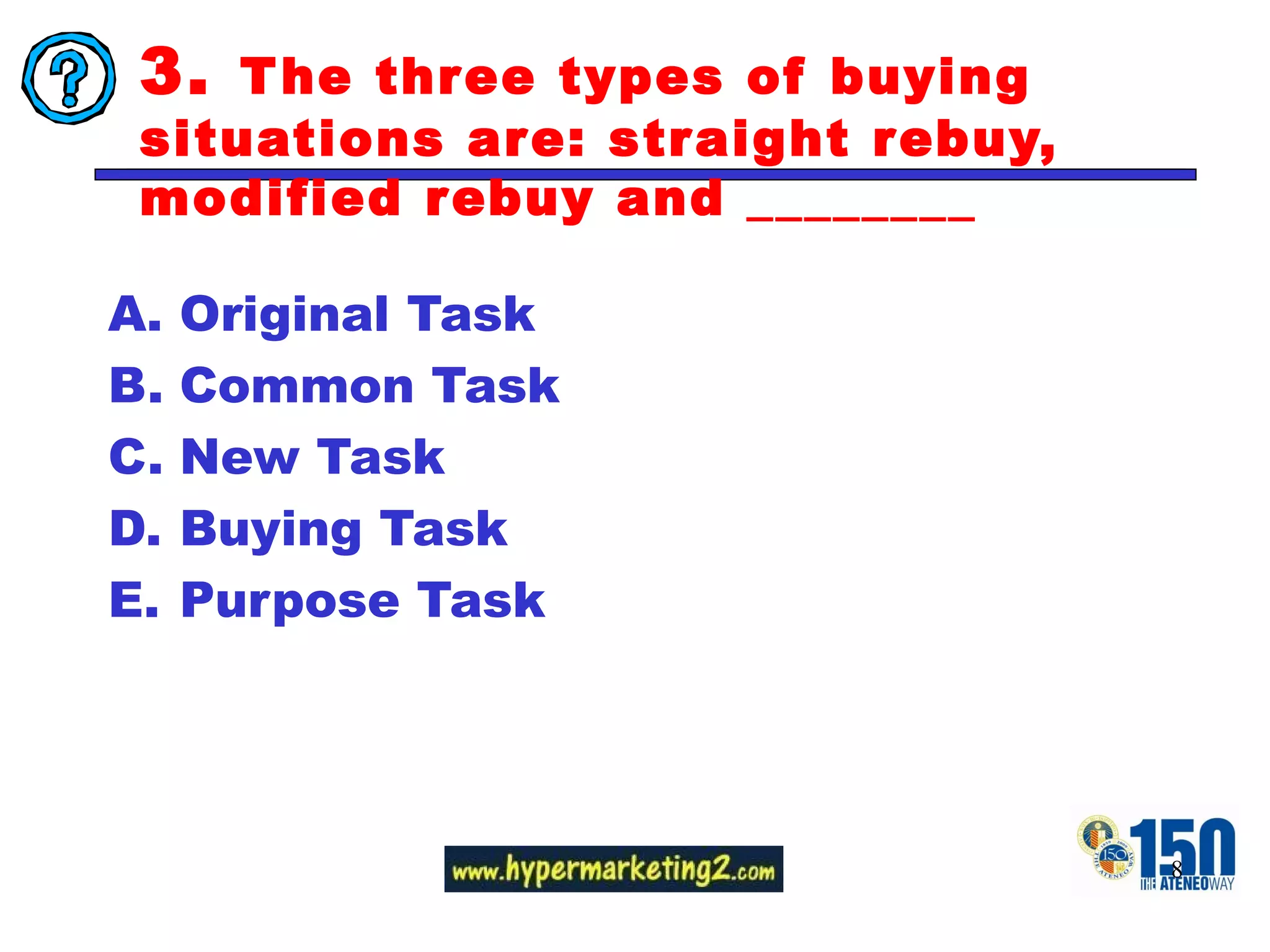
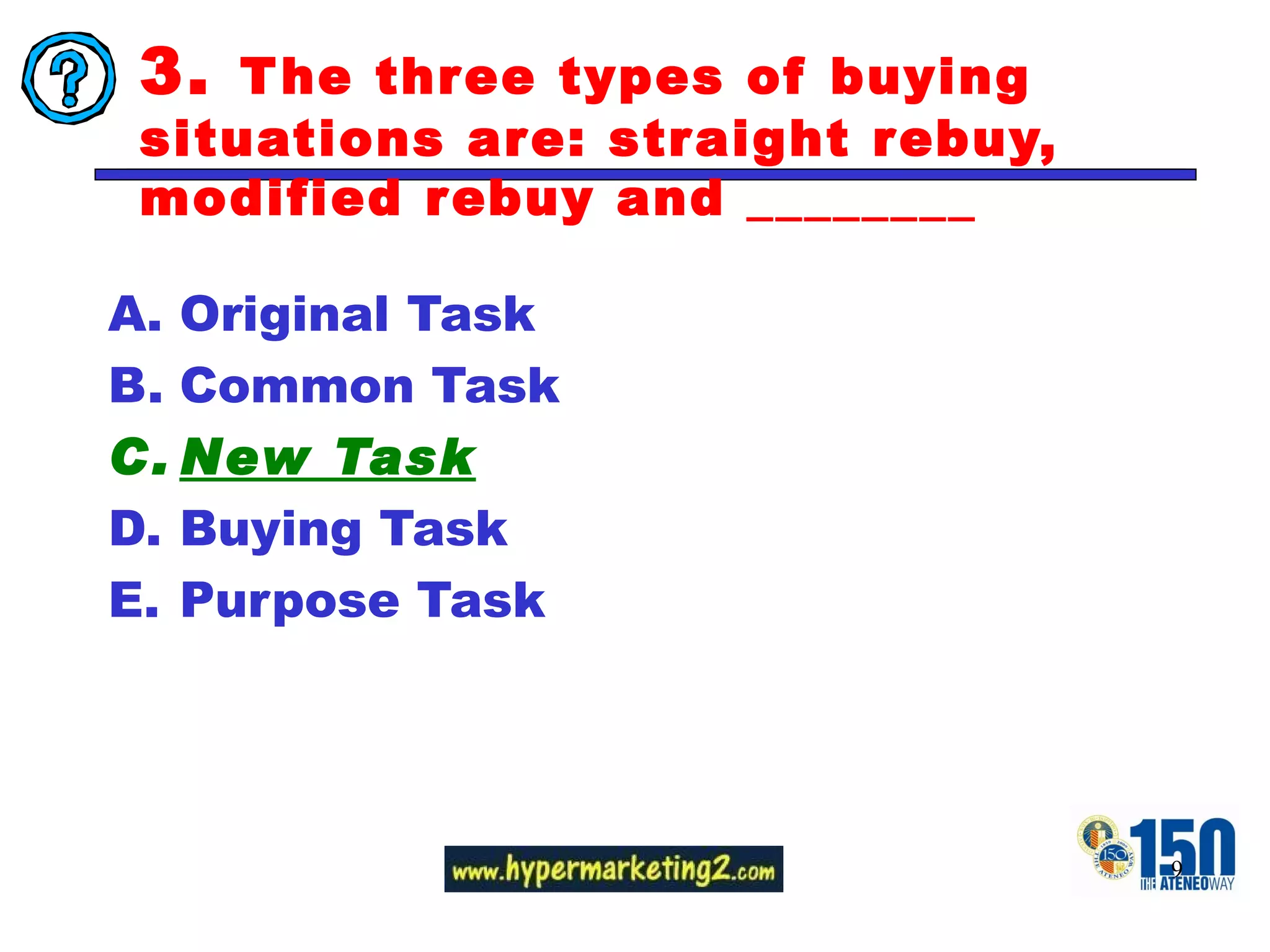
3.  The three types of buying situations are: straight rebuy, modified rebuy and ________ Original Task Common Task New Task Buying Task Purpose Task
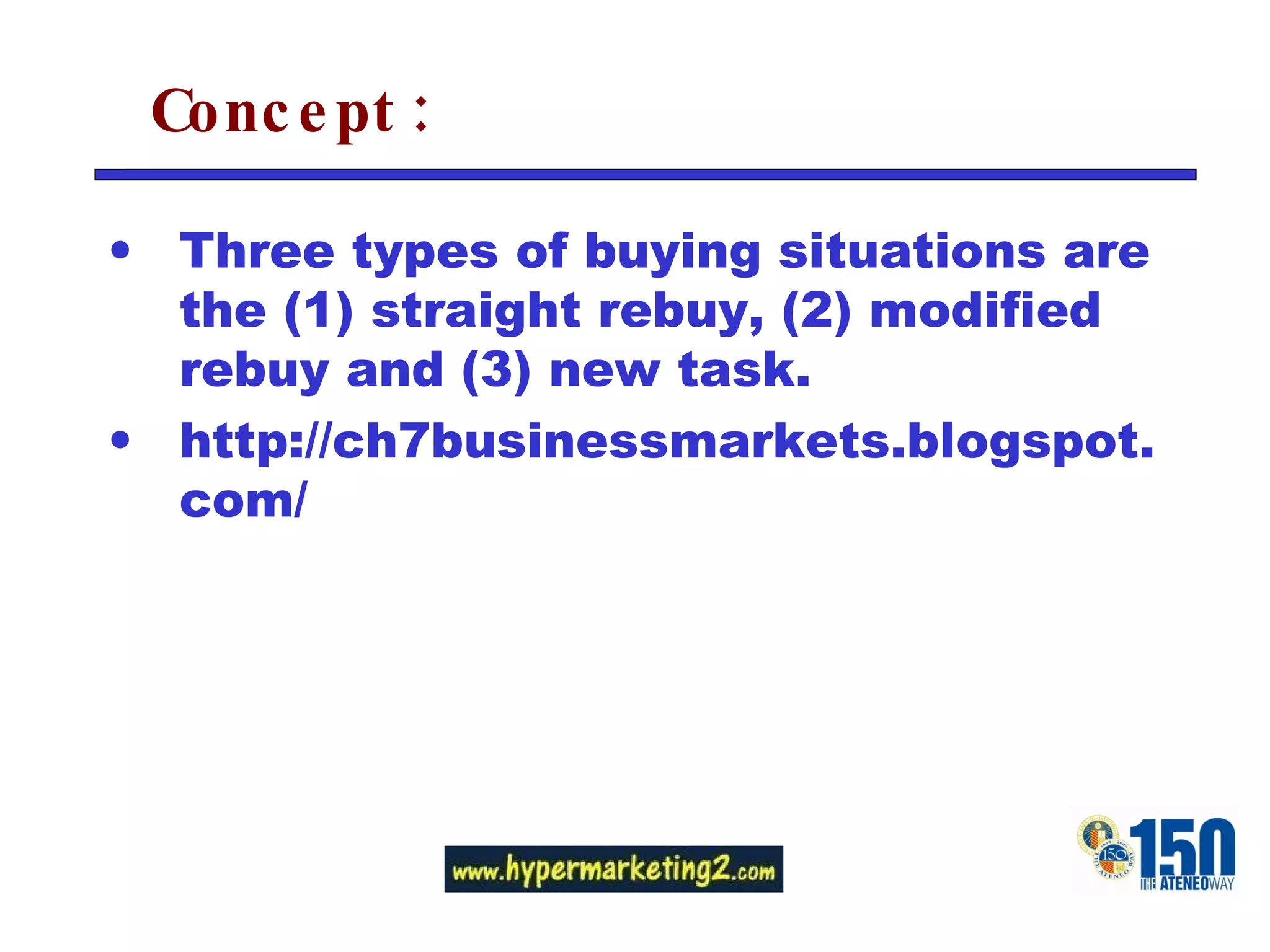
Concept: Three types of buying situations are the (1) straight rebuy, (2) modified rebuy and (3) new task. http://ch7businessmarkets.blogspot.com/
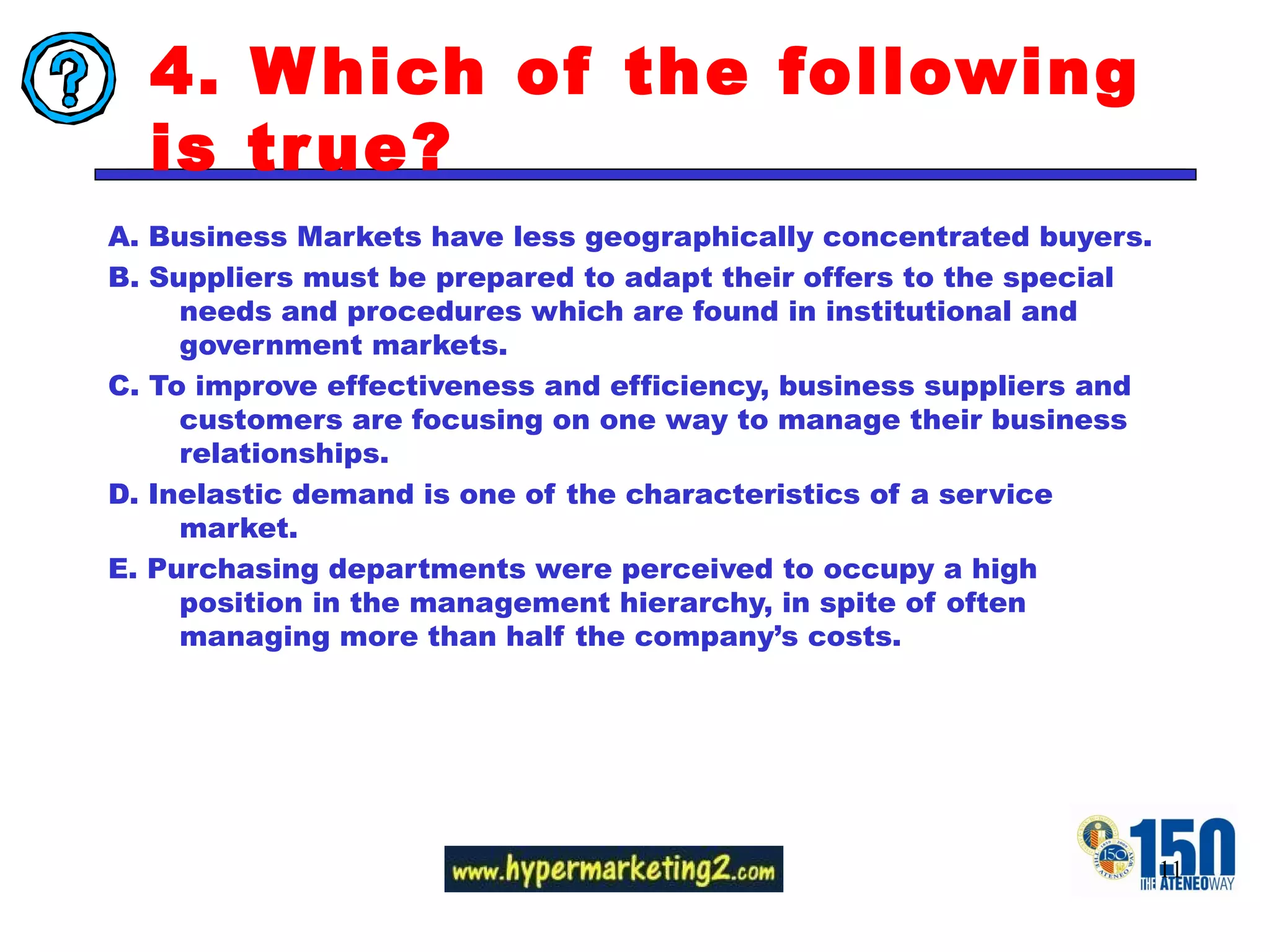
4. Which of the following is true? A. Business Markets have less geographically concentrated buyers. B. Suppliers must be prepared to adapt their offers to the special needs and procedures which are found in institutional and government markets. C. To improve effectiveness and efficiency, business suppliers and customers are focusing on one way to manage their business relationships.  D. Inelastic demand is one of the characteristics of a service market.  E. Purchasing departments were perceived to occupy a high  position in the management hierarchy, in spite of often managing more than half the company’s costs.
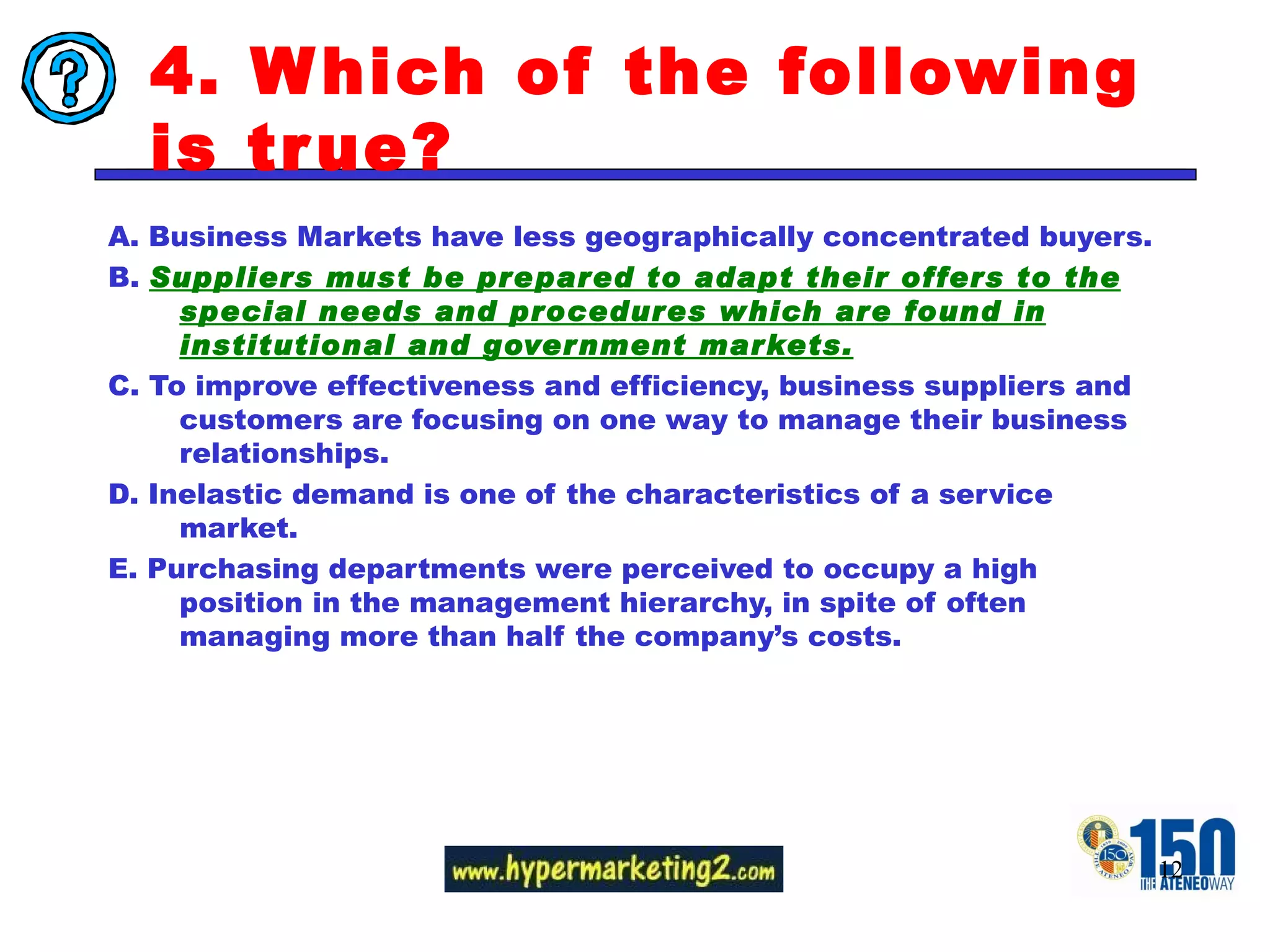
4. Which of the following is true? A. Business Markets have less geographically concentrated buyers. B.  Suppliers must be prepared to adapt their offers to the special needs and procedures which are found in institutional and government markets. C. To improve effectiveness and efficiency, business suppliers and customers are focusing on one way to manage their business relationships.  D. Inelastic demand is one of the characteristics of a service market.  E. Purchasing departments were perceived to occupy a high  position in the management hierarchy, in spite of often managing more than half the company’s costs.
Concept: Institutional & Government Markets consist of schools, hospitals, nursing homes, prisons and other institutions that provide goods and services to people in their care. Buyers for government organizations tend to require a great deal of paperwork from their vendors and to favor open bidding and domestic companies. Suppliers must be prepared to adapt their offers to the special needs and procedures found in institutional and government markets. http://ch7businessmarkets.blogspot.com/
5. __________________consist of schools, hospitals, nursing homes, prisons and other institutions that provide goods and services to people in their care. Organizational Markets Public and Private Instituitions Service Markets Suppliers and Consumers Instituitional and Government Markets
Concept: Institutional & Government Markets consist of schools, hospitals, nursing homes, prisons and other institutions that provide goods and services to people in their care. Buyers for government organizations tend to require a great deal of paperwork from their vendors and to favor open bidding and domestic companies. Suppliers must be prepared to adapt their offers to the special needs and procedures found in institutional and government markets. http://ch7businessmarkets.blogspot.com/
6.  When Whirlpool acquired the services of IBM to facilitate faster and more efficient inventory management, it is an example of:   Systems Buying Merging Total Quality Management Outsourcing Straight Rebuy
Concept: Many business buyers prefer to buy a total solution to a problem from one seller. This is called systems buying. http://ch7businessmarkets.blogspot.com/
7.  The first stage in the buying process is usually called:  Observation of current market General Description of the need Product and Supplier Specification Problem recognition Probing and Identifying the need.
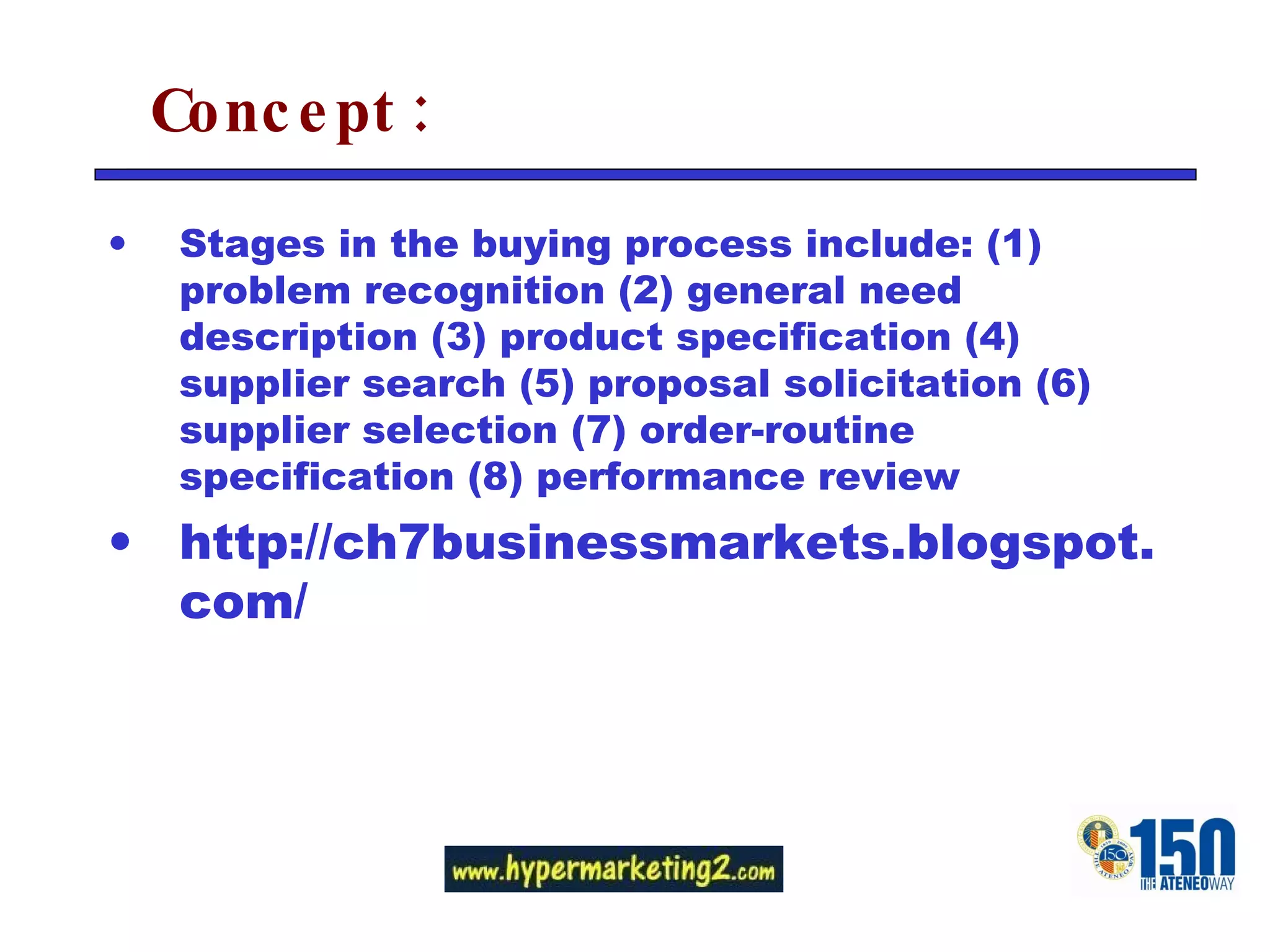
Concept: Stages in the buying process include: (1) problem recognition (2) general need description (3) product specification (4) supplier search (5) proposal solicitation (6) supplier selection (7) order-routine specification (8) performance review http://ch7businessmarkets.blogspot.com/
8.  Systems buying is defined as: Buyers improve the system by acquiring a new company with a better facility.  General merging of 2 partner companies for better system management.  Product and Supplier Relationship made better by new and advanced system Outsourcing of new system from other parties.  Buyers prefer to buy a total solution to a problem from one seller
Concept: Many business buyers prefer to buy a total solution to a problem from one seller. This is called systems buying. http://ch7businessmarkets.blogspot.com/
9. Which of the following is false?  A.   Buyers for government organizations tend to require a great deal of paperwork from their vendors and to favor open bidding and domestic companies B.  Usually, performance review is an option when talking about the buying process. C.  Business Markets as compared with Consumer Markets have fewer, larger buyers. D.  Business marketers must form strong bonds and relationships with their customers and provide them added value. E.  Closer relationships are driven in part by supply chain management, early supplier involvement and purchasing alliances.
Concept: Stages in the buying process include: (1) problem recognition (2) general need description (3) product specification (4) supplier search (5) proposal solicitation (6) supplier selection (7) order-routine specification (8) performance review http://ch7businessmarkets.blogspot.com/
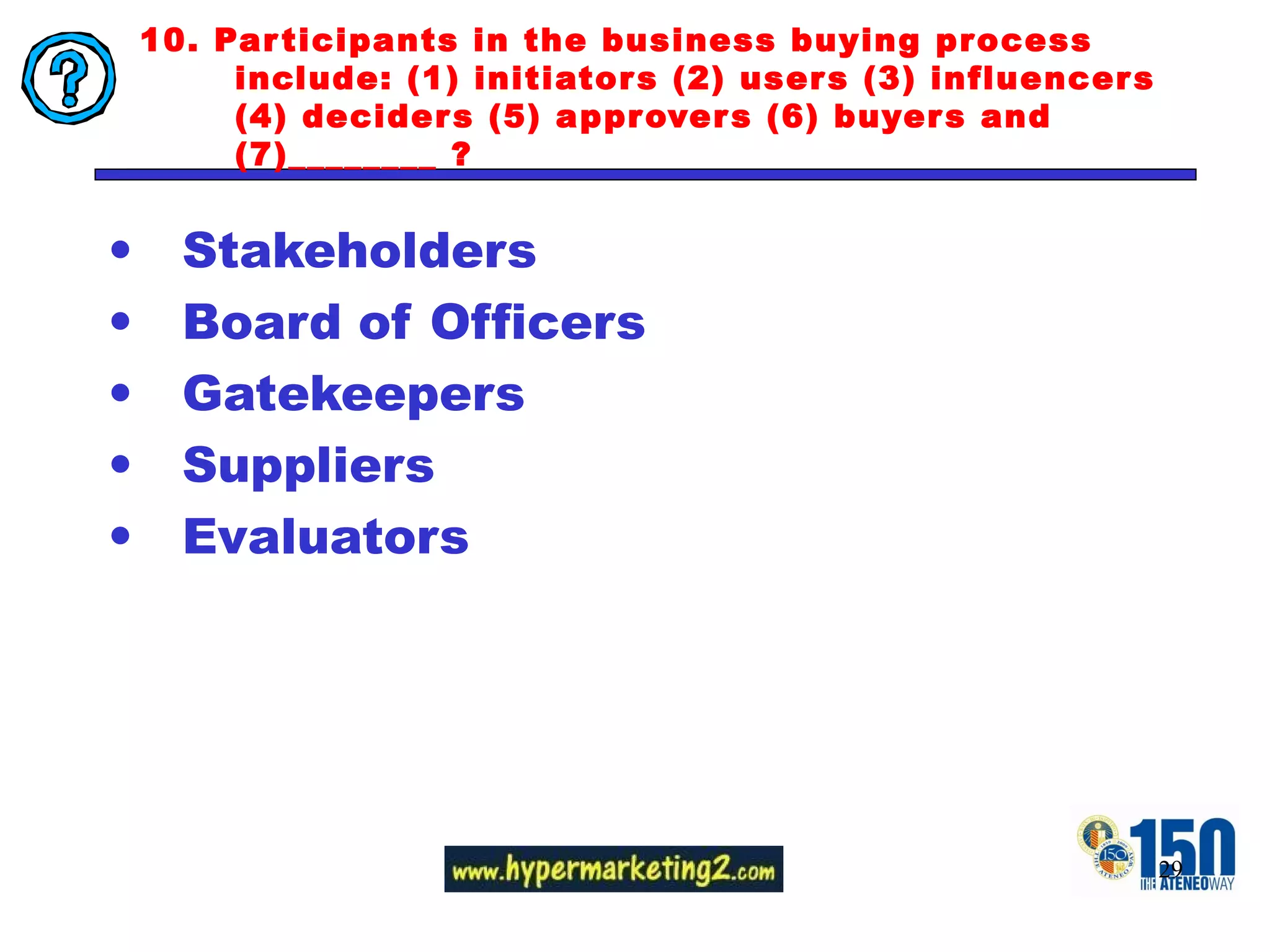
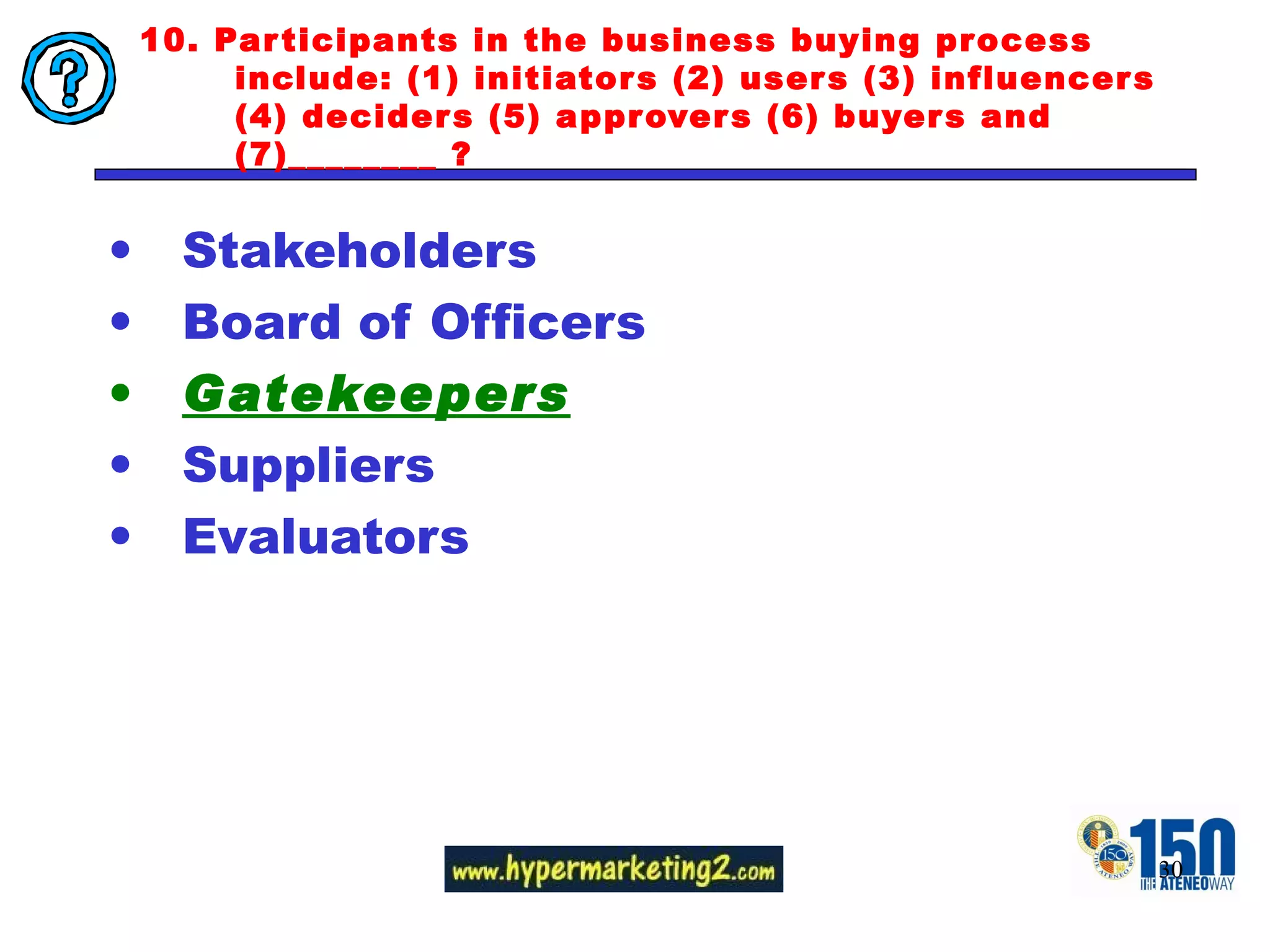
10. Participants in the business buying process include: (1) initiators (2) users (3) influencers (4) deciders (5) approvers (6) buyers and (7)________ ? Stakeholders Board of Officers Gatekeepers Suppliers Evaluators
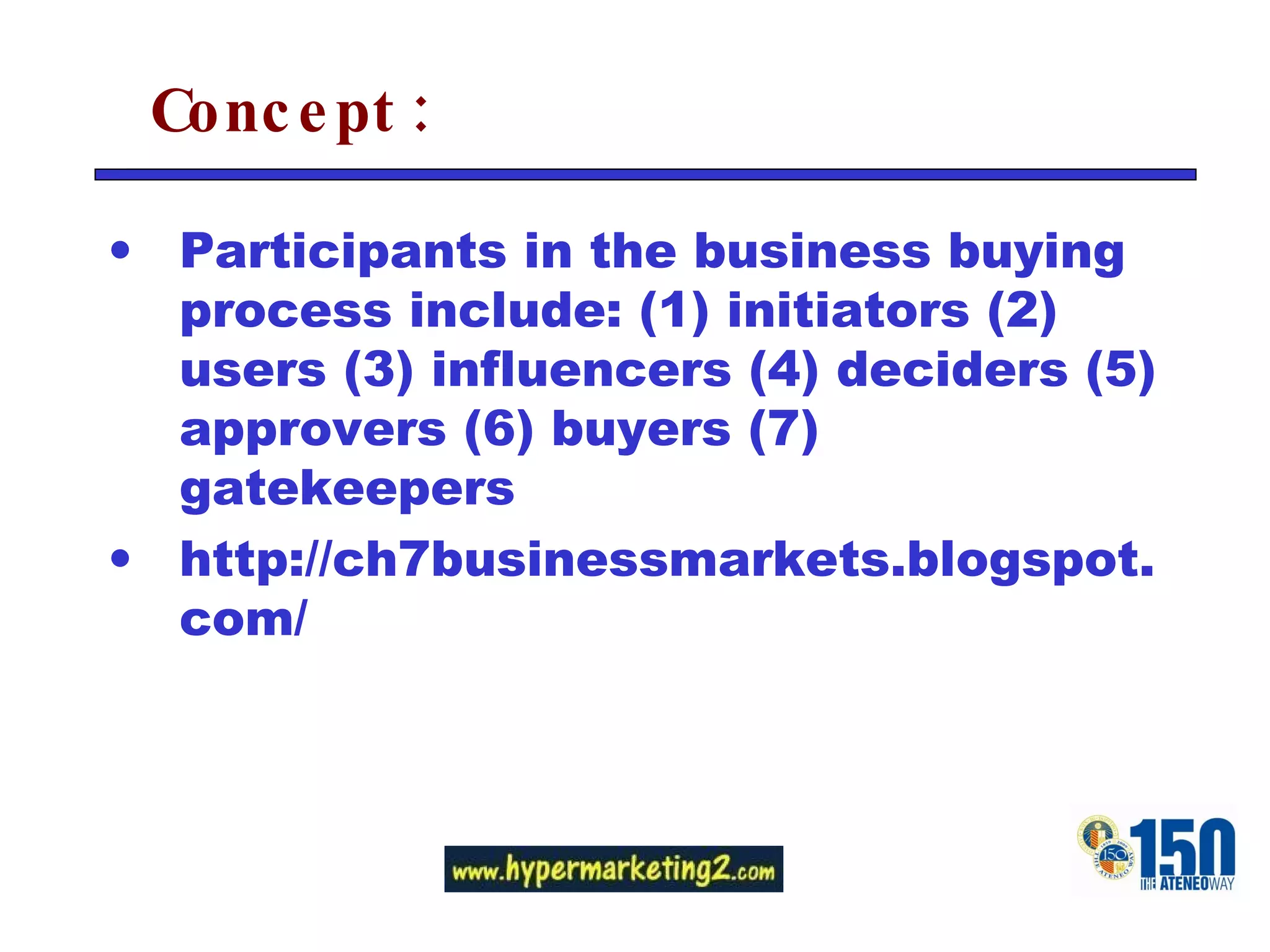
Concept: Participants in the business buying process include: (1) initiators (2) users (3) influencers (4) deciders (5) approvers (6) buyers (7) gatekeepers http://ch7businessmarkets.blogspot.com/

Markma 10 questions

  • 1.
    10 Questions forlearning (Analyzing Business Markets: Chapter 7) Leeyhan Frank B. Dizon September 3, 2010
  • 2.
    1. ______decision-making process by which formal organizations establish the need to purchase products and services Organizational Buying Straight Rebuy Market Buying Outsourcing Direct Purchasing
  • 3.
    1. ______decision-making process by which formal organizations establish the need to purchase products and services Organizational Buying Straight Rebuy Market Buying Outsourcing Direct Purchasing
  • 4.
    Concept: Organizational buyingis the decision-making process by which formal organizations establish the need to purchase products and services and identify, evaluate and choose among alternative brands and suppliers. http://ch7businessmarkets.blogspot.com/
  • 5.
    2. All arecharacteristics of Business Markets except Fewer, Larger Buyers Direct and Indirect Purchasing System Inelastic Demand Fluctuating Demand Close supplier-customer relationships
  • 6.
    2. All arecharacteristics of Business Markets except Fewer, Larger Buyers Direct and Indirect Purchasing System Inelastic Demand Fluctuating Demand Close supplier-customer relationships
  • 7.
    Concept: Slide number3 from the reading materials “ Characteristics of Business Markets”
  • 8.
    3. Thethree types of buying situations are: straight rebuy, modified rebuy and ________ Original Task Common Task New Task Buying Task Purpose Task
  • 9.
    3. Thethree types of buying situations are: straight rebuy, modified rebuy and ________ Original Task Common Task New Task Buying Task Purpose Task
  • 10.
    Concept: Three typesof buying situations are the (1) straight rebuy, (2) modified rebuy and (3) new task. http://ch7businessmarkets.blogspot.com/
  • 11.
    4. Which ofthe following is true? A. Business Markets have less geographically concentrated buyers. B. Suppliers must be prepared to adapt their offers to the special needs and procedures which are found in institutional and government markets. C. To improve effectiveness and efficiency, business suppliers and customers are focusing on one way to manage their business relationships. D. Inelastic demand is one of the characteristics of a service market. E. Purchasing departments were perceived to occupy a high position in the management hierarchy, in spite of often managing more than half the company’s costs.
  • 12.
    4. Which ofthe following is true? A. Business Markets have less geographically concentrated buyers. B. Suppliers must be prepared to adapt their offers to the special needs and procedures which are found in institutional and government markets. C. To improve effectiveness and efficiency, business suppliers and customers are focusing on one way to manage their business relationships. D. Inelastic demand is one of the characteristics of a service market. E. Purchasing departments were perceived to occupy a high position in the management hierarchy, in spite of often managing more than half the company’s costs.
  • 13.
    Concept: Institutional &Government Markets consist of schools, hospitals, nursing homes, prisons and other institutions that provide goods and services to people in their care. Buyers for government organizations tend to require a great deal of paperwork from their vendors and to favor open bidding and domestic companies. Suppliers must be prepared to adapt their offers to the special needs and procedures found in institutional and government markets. http://ch7businessmarkets.blogspot.com/
  • 14.
    5. __________________consist ofschools, hospitals, nursing homes, prisons and other institutions that provide goods and services to people in their care. Organizational Markets Public and Private Instituitions Service Markets Suppliers and Consumers Instituitional and Government Markets
  • 15.
    5. __________________consist ofschools, hospitals, nursing homes, prisons and other institutions that provide goods and services to people in their care. Organizational Markets Public and Private Instituitions Service Markets Suppliers and Consumers Instituitional and Government Markets
  • 16.
    Concept: Institutional &Government Markets consist of schools, hospitals, nursing homes, prisons and other institutions that provide goods and services to people in their care. Buyers for government organizations tend to require a great deal of paperwork from their vendors and to favor open bidding and domestic companies. Suppliers must be prepared to adapt their offers to the special needs and procedures found in institutional and government markets. http://ch7businessmarkets.blogspot.com/
  • 17.
    6. WhenWhirlpool acquired the services of IBM to facilitate faster and more efficient inventory management, it is an example of: Systems Buying Merging Total Quality Management Outsourcing Straight Rebuy
  • 18.
    6. WhenWhirlpool acquired the services of IBM to facilitate faster and more efficient inventory management, it is an example of: Systems Buying Merging Total Quality Management Outsourcing Straight Rebuy
  • 19.
    Concept: Many businessbuyers prefer to buy a total solution to a problem from one seller. This is called systems buying. http://ch7businessmarkets.blogspot.com/
  • 20.
    7. Thefirst stage in the buying process is usually called: Observation of current market General Description of the need Product and Supplier Specification Problem recognition Probing and Identifying the need.
  • 21.
    7. Thefirst stage in the buying process is usually called: Observation of current market General Description of the need Product and Supplier Specification Problem recognition Probing and Identifying the need.
  • 22.
    Concept: Stages inthe buying process include: (1) problem recognition (2) general need description (3) product specification (4) supplier search (5) proposal solicitation (6) supplier selection (7) order-routine specification (8) performance review http://ch7businessmarkets.blogspot.com/
  • 23.
    8. Systemsbuying is defined as: Buyers improve the system by acquiring a new company with a better facility. General merging of 2 partner companies for better system management. Product and Supplier Relationship made better by new and advanced system Outsourcing of new system from other parties. Buyers prefer to buy a total solution to a problem from one seller
  • 24.
    8. Systemsbuying is defined as: Buyers improve the system by acquiring a new company with a better facility. General merging of 2 partner companies for better system management. Product and Supplier Relationship made better by new and advanced system Outsourcing of new system from other parties. Buyers prefer to buy a total solution to a problem from one seller
  • 25.
    Concept: Many businessbuyers prefer to buy a total solution to a problem from one seller. This is called systems buying. http://ch7businessmarkets.blogspot.com/
  • 26.
    9. Which ofthe following is false? A. Buyers for government organizations tend to require a great deal of paperwork from their vendors and to favor open bidding and domestic companies B. Usually, performance review is an option when talking about the buying process. C. Business Markets as compared with Consumer Markets have fewer, larger buyers. D. Business marketers must form strong bonds and relationships with their customers and provide them added value. E. Closer relationships are driven in part by supply chain management, early supplier involvement and purchasing alliances.
  • 27.
    9. Which ofthe following is false? A. Buyers for government organizations tend to require a great deal of paperwork from their vendors and to favor open bidding and domestic companies B. Usually, performance review is an option when talking about the buying process. C. Business Markets as compared with Consumer Markets have fewer, larger buyers. D. Business marketers must form strong bonds and relationships with their customers and provide them added value. E. Closer relationships are driven in part by supply chain management, early supplier involvement and purchasing alliances.
  • 28.
    Concept: Stages inthe buying process include: (1) problem recognition (2) general need description (3) product specification (4) supplier search (5) proposal solicitation (6) supplier selection (7) order-routine specification (8) performance review http://ch7businessmarkets.blogspot.com/
  • 29.
    10. Participants inthe business buying process include: (1) initiators (2) users (3) influencers (4) deciders (5) approvers (6) buyers and (7)________ ? Stakeholders Board of Officers Gatekeepers Suppliers Evaluators
  • 30.
    10. Participants inthe business buying process include: (1) initiators (2) users (3) influencers (4) deciders (5) approvers (6) buyers and (7)________ ? Stakeholders Board of Officers Gatekeepers Suppliers Evaluators
  • 31.
    Concept: Participants inthe business buying process include: (1) initiators (2) users (3) influencers (4) deciders (5) approvers (6) buyers (7) gatekeepers http://ch7businessmarkets.blogspot.com/